Morph-ora
International Antalya Architecture Biennale 4.5 "Arada / In-Between" (IABA 2025), open call selection
A joint work of the GTU Water-Ground first-year architectural design studio. Arising from experimental research at Tuzla Lagoon, the project combines biotechnology, materials science, ecology and digital fabrication to question the idea of fixed space and proposes living systems that respond to environmental conditions. The exhibition presented models, panels, videos and material samples together.
The biennale was organised by the Antalya Branch of the Chamber of Architects of Turkey (TMMOB) and hosted by Kepez Municipality (3–9 November 2025; biennale chair C. Abdi Güzer, curators Lale Özgenel and Elvan Hazal Türkyılmaz Bilgiç). It bears the name "4.5" because the fifth biennale, due in 2019, was postponed owing to the pandemic. The open call selections were exhibited at the Pil Fabrikası Campus; the selection committee comprised Lale Özgenel, Elvan Hazal Türkyılmaz Bilgiç, Tülin Görgülü, Kemal Reha Kavas, Pelin Yoncacı Arslan, Onur Özkoç and Doğan Türkkan.
Project: Morph-ora / Morf-ora
Morph-ora is an experimental research and design process within the Responsive Ground Research Lab (RGRL) that examines transcalar water-based tectonics in Tuzla Lagoon. It approaches space not as a fixed and defined physical entity but as a living system that reacts to changing environmental factors.
The biennale's "In-Between" theme offered a framework for questioning this approach: in a setting where the in-betweens of natural–artificial, data–material and analogue–digital intertwine, design is positioned as "a living modifier". Coastal and lagoon areas were read as dynamic sites that act as an in-between of water and land and contain the layered structure of ecological systems.
Process
Rather than a search for stereotyped typological form, the process was set up as a field of topological thinking. Prototypes were produced at different scales using biomaterials and 3D printing techniques; digital and analogue environments were used simultaneously. Digital design environments were treated not merely as platforms for form modelling but as perceptual agents.
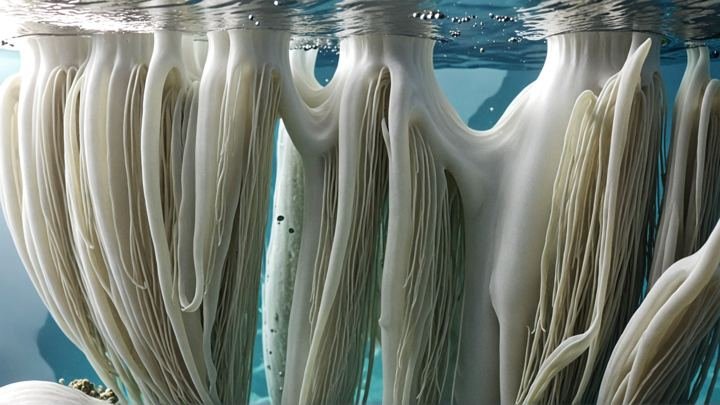
Artificial intelligence was used to simulate the spatial dynamics emerging in the experimental process and to analyse how they might evolve over time. Scenarios derived from algorithmic growth structures provided the ground for ecological narratives at the interrelated scales of the lagoon:
- bridges below and above surfaces
- adhesive rock formations for aquatic species
- floating biofilms
- nests for aquatic creatures
Prototypes and 1:1 model
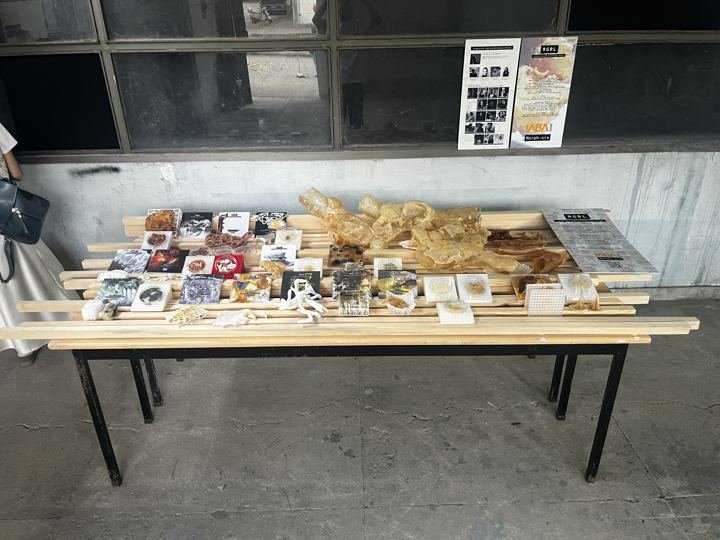
Prototypes of approximately 20×20 cm propose a connector system addressing the transitions between below and above the water surface; biomaterial-based hybrid structures aim at surface textures open to interaction with living species. Process diagrams show the stages extending from the reading of topographic and hydrological data to design parameters and physical prototyping.
To simulate the bio-configurative parts, a 1:1 scale hybrid "Morph-ora" model of approximately 80×120 cm was developed. The model was presented as the physical projection of an alternative building practice seeking new ways of thinking "in-between" with water.
Exhibition
In the open call selection at the Pil Fabrikası Campus, the prototypes, the 1:1 model, process panels and video were shown together on an exhibition table. With a non-anthropocentric understanding of architecture, the project proposes a shared ground for life through relationships established with aquatic organisms, micro-organisms and environmental data.